RER D map
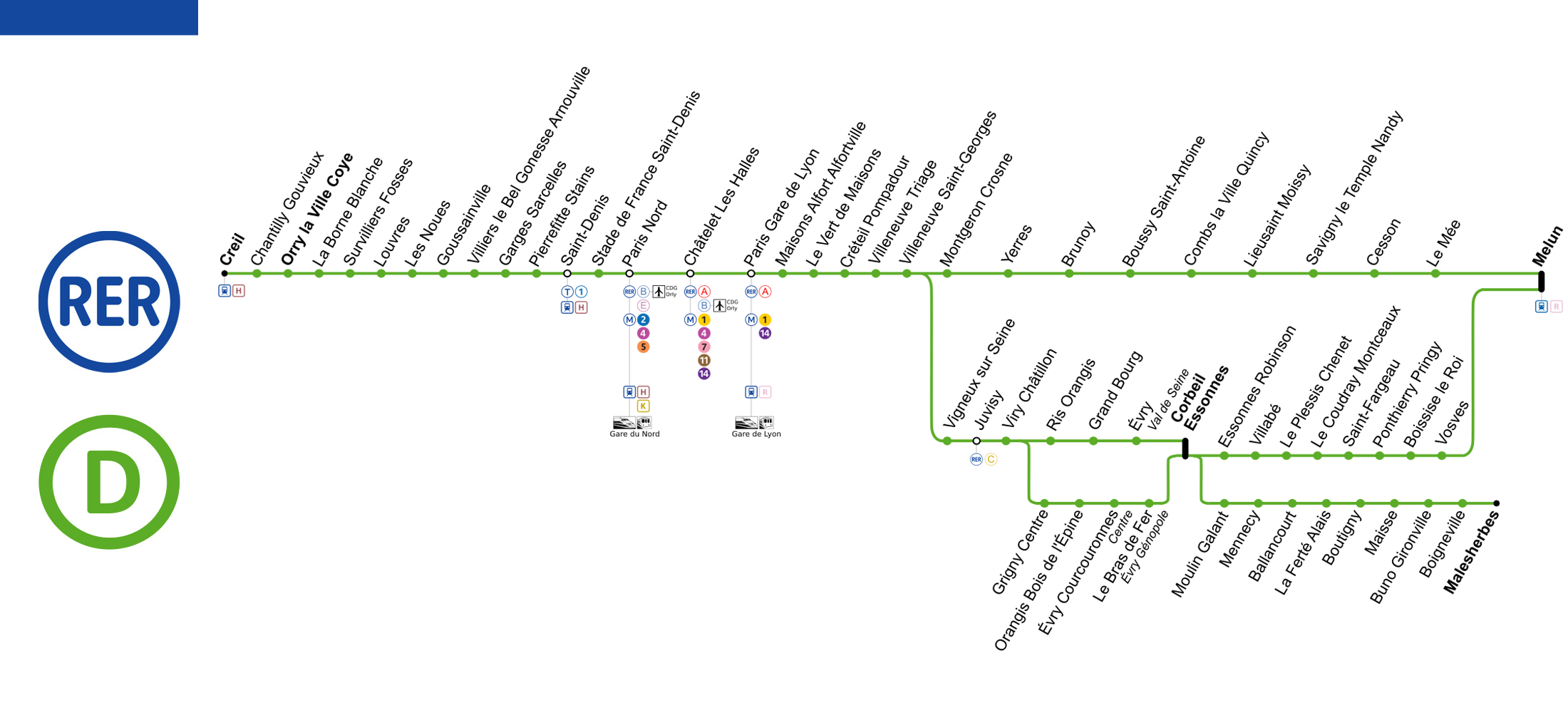
The Paris RER D is a major north-south suburban rail line connecting central Paris with many towns across the Île-de-France region. For visitors, it is particularly useful for travelling between Gare du Nord, Châtelet – Les Halles, Gare de Lyon and the Stade de France.
This guide includes the RER D map, route, stations, ticket prices, connections and practical travel tips.
RER D at a Glance
🛡 Travel Safety Tip
The RER D is heavily used by commuters and trains can become crowded, particularly around Gare du Nord, Châtelet – Les Halles and Gare de Lyon.
Keep your phone, wallet and other valuables inside secure pockets or zipped compartments and pay attention when boarding or leaving crowded trains.
RER D Overview
RER D crosses the Paris region from north to south and serves a large number of suburban communities as well as three of the most important railway stations in central Paris.
The northern section runs toward destinations including Orry-la-Ville and Creil, while the southern network serves destinations including Melun, Corbeil-Essonnes and Malesherbes.
For visitors, the most useful part of the line is generally the central section between Gare du Nord, Châtelet – Les Halles and Gare de Lyon. The RER D also provides convenient access to the Stade de France.
How to Get to Stade de France by RER D
The RER D is one of the easiest ways to reach the Stade de France from central Paris. Get off at Stade de France – Saint-Denis.
- Station: Stade de France – Saint-Denis
- From Gare du Nord: only one RER D stop
- 2026 ticket price: €2.55
- Walking time: approximately 10–15 minutes to the stadium, depending on your entrance
- Best for: football matches, rugby matches, concerts and major events
The standard Metro-Train-RER Ticket costs €2.55 in 2026, so travelling from central Paris to Stade de France – Saint-Denis no longer requires the old distance-based fare.
Check events and visitor information on the official Stade de France website →
Tourist Attractions and Useful Destinations on RER D
The RER D is primarily a commuter line rather than a sightseeing route, but several stations are useful for visitors.
Stade de France
The Stade de France is served by Stade de France – Saint-Denis station. It hosts major football and rugby matches, concerts and international events.
Central Paris
Châtelet – Les Halles is located in the centre of Paris and provides connections to numerous Metro and RER lines. From here, visitors can easily reach many of the city’s main attractions.
Gare du Nord
Gare du Nord is one of Europe’s busiest railway stations and an important hub for international, national and regional train services.
Gare de Lyon
Gare de Lyon is a major railway station for trains travelling toward destinations including Lyon, Marseille and the south-east of France.
RER D stations
The RER D serves many suburban stations, but the following stations are particularly useful for visitors travelling through Paris:
- Stade de France – Saint-Denis is the main RER D station for the Stade de France.
- Gare du Nord provides connections with international trains, regional trains, the RER B and several Metro services.
- Châtelet – Les Halles is one of the largest transport hubs in Paris and provides numerous Metro and RER connections.
- Gare de Lyon provides connections with the RER A, Metro lines 1 and 14 and numerous national and international trains.
- Maisons-Alfort – Alfortville serves the south-eastern suburbs of Paris.
- Villeneuve-Saint-Georges is an important junction on the southern part of the RER D.
- Juvisy is a major interchange in southern Île-de-France and provides connections with RER C.
- Corbeil-Essonnes is an important junction between several southern RER D branches.
- Melun is one of the main southern destinations of the RER D.
Train Stations on RER D
The RER D directly serves two of the most important long-distance railway stations in Paris: Gare du Nord and Gare de Lyon.
- Gare du Nord provides international and national rail connections as well as access to the RER B and Paris Metro.
- Gare de Lyon provides TGV and other rail services toward Lyon, Marseille, the French Alps, Switzerland, Italy and other destinations.
Metro and RER lines connected to RER D
- Metro 4, Metro 5, RER B, RER E via Magenta and Metro 2 via La Chapelle at Gare du Nord.
- Metro 1, Metro 4, Metro 7, Metro 11, Metro 14, RER A and RER B at Châtelet – Les Halles.
- Metro 1, Metro 14 and RER A at Gare de Lyon.
- RER C at Juvisy.
RER D Ticket Price
The Île-de-France public transport fare system has been simplified. In 2026, a standard Metro-Train-RER Ticket costs €2.55 at full fare and can be used for eligible journeys on the Metro, train and RER network regardless of the distance travelled.
This means that a journey from central Paris to Stade de France – Saint-Denis costs the standard €2.55 fare. The old distance-based fare system no longer applies to this journey.
The main exceptions to the standard Metro-Train-RER fare concern direct rail access to Charles de Gaulle and Orly airports, which use the separate Paris Region ↔ Airports fare.
To compare public transport options in Paris, including Metro, RER, buses and airport transfers, check this complete Paris transport guide →
TIP : Use The 4 Day Paris All-Inclusive Pass and get FREE entrance to the Eiffel Tower, the Louvre Museum, the Palace of Versailles, the Arc de Triomphe, 1 day hop-on, hop-off Paris bus tour, a Seine river cruise, a French wine tasting in the Louvre cellar and many other activities.
RER D timetable
You can check current RER D departure times, service information and planned works on the official Transilien RER D page.
The RER D has several branches, so always check the destination displayed on the platform before boarding. A train travelling in the correct general direction may not necessarily serve your destination.
RER D northbound toward Stade de France / Orry-la-Ville / Creil
For Stade de France, take a northbound RER D train that stops at Stade de France – Saint-Denis.
RER D southbound toward Melun / Corbeil-Essonnes
Southbound trains divide into different branches after leaving central Paris. Check the destination and stopping pattern before boarding.
RER D toward Malesherbes
The Malesherbes branch operates on the southern part of the RER D network. Depending on your journey, a connection may be required rather than a direct train from central Paris.
FAQ – Frequently Asked Questions About the RER D
Does the RER D go to Stade de France?
Yes. Get off at Stade de France – Saint-Denis. It is only one RER D stop north of Gare du Nord.
How much is the RER D from Paris to Stade de France in 2026?
A standard Metro-Train-RER Ticket costs €2.55 in 2026 and can be used for this journey.
Which RER station should I use for Stade de France?
On RER D, use Stade de France – Saint-Denis. From there, follow signs and pedestrian routes toward the stadium.
How long does it take from Gare du Nord to Stade de France on RER D?
Stade de France – Saint-Denis is the next RER D station after Gare du Nord when travelling north, so the train journey itself takes only a few minutes.
Does the RER D go to Gare du Nord?
Yes. Gare du Nord is one of the main stations on RER D and provides numerous Metro, RER and long-distance train connections.
Does the RER D stop at Châtelet – Les Halles?
Yes. Châtelet – Les Halles is one of the three principal RER D stations in central Paris and provides connections with RER A, RER B and Metro lines 1, 4, 7, 11 and 14.
Does the RER D go to Gare de Lyon?
Yes. Gare de Lyon is a major RER D station and provides connections with RER A, Metro 1, Metro 14 and long-distance trains.
Can I take RER D from Gare du Nord to Gare de Lyon?
Yes. Under normal service conditions, RER D provides a direct connection between Gare du Nord and Gare de Lyon, with Châtelet – Les Halles between them.
How much does a normal RER D journey cost in 2026?
A standard Metro-Train-RER Ticket costs €2.55 at full fare in 2026.
Does RER D cost more outside Paris?
For eligible RER journeys in Île-de-France, the standard Metro-Train-RER Ticket now uses a flat fare of €2.55 rather than the old distance-based fare system. Airport access is subject to separate rules.
Can I use Navigo on RER D?
Yes. Navigo passes can be used on the RER D according to the validity and conditions of your particular pass.
Does every RER D train follow the same route?
No. The RER D has several northern and southern branches. Always check the final destination and stopping pattern before boarding.
Does every northbound RER D train stop at Stade de France?
Service patterns can vary, so check the platform display and make sure Stade de France – Saint-Denis appears among the stops before boarding.
Does RER D go to Charles de Gaulle Airport?
No. Charles de Gaulle Airport is served by RER B. You can change from RER D to RER B at Gare du Nord or Châtelet – Les Halles.
Does RER D go to Orly Airport?
No. RER D does not directly serve Orly Airport. Metro Line 14 provides a direct rail connection between central Paris and Orly Airport.
Can I change from RER D to RER A?
Yes. You can change between RER D and RER A at Châtelet – Les Halles and Gare de Lyon.
Can I change from RER D to RER B?
Yes. RER D and RER B both serve Gare du Nord and Châtelet – Les Halles.
Can I change from RER D to RER C?
Yes. One useful connection between the RER D and RER C is available at Juvisy.
How often does the RER D run?
RER D trains are frequent on the central section through Paris. Waiting times are generally longer on individual suburban branches, so check the current timetable for your destination.
What time does the RER D start running?
RER D services generally begin in the early morning at around 5:00 AM. Exact times depend on the station and branch.
What time does the RER D stop running?
Services normally continue until shortly after midnight on many sections. The last train varies significantly by branch, so check Transilien before travelling late at night.
Can I take luggage on RER D?
Yes. Luggage is allowed on RER D trains. Keep bags close to you and avoid blocking doors and aisles, especially during rush hour.
Is RER D useful for tourists?
Yes, although it is primarily a commuter line. It is particularly useful for reaching Stade de France, Gare du Nord, Châtelet – Les Halles and Gare de Lyon and for connecting with other RER and Metro lines.