RER D at a Glance
| Main Route | Orry-la-Ville / Creil ↔ Melun / Corbeil-Essonnes / Malesherbes |
|---|---|
| Number of Stations | More than 50 stations |
| Total Length | Approximately 190 km (118 miles) |
| Travel Time to Gare du Nord | A few minutes from Châtelet – Les Halles |
| Travel Time to Gare de Lyon | About 5 minutes from Châtelet – Les Halles |
| First Train | Around 5:00 AM |
| Last Train | Around 12:30 AM |
| Frequency | Every 5 to 15 minutes depending on the route and time of day |
| Serves Stade de France? | Yes |
| Serves Gare du Nord? | Yes |
| Valid with Navigo Pass? | Yes |
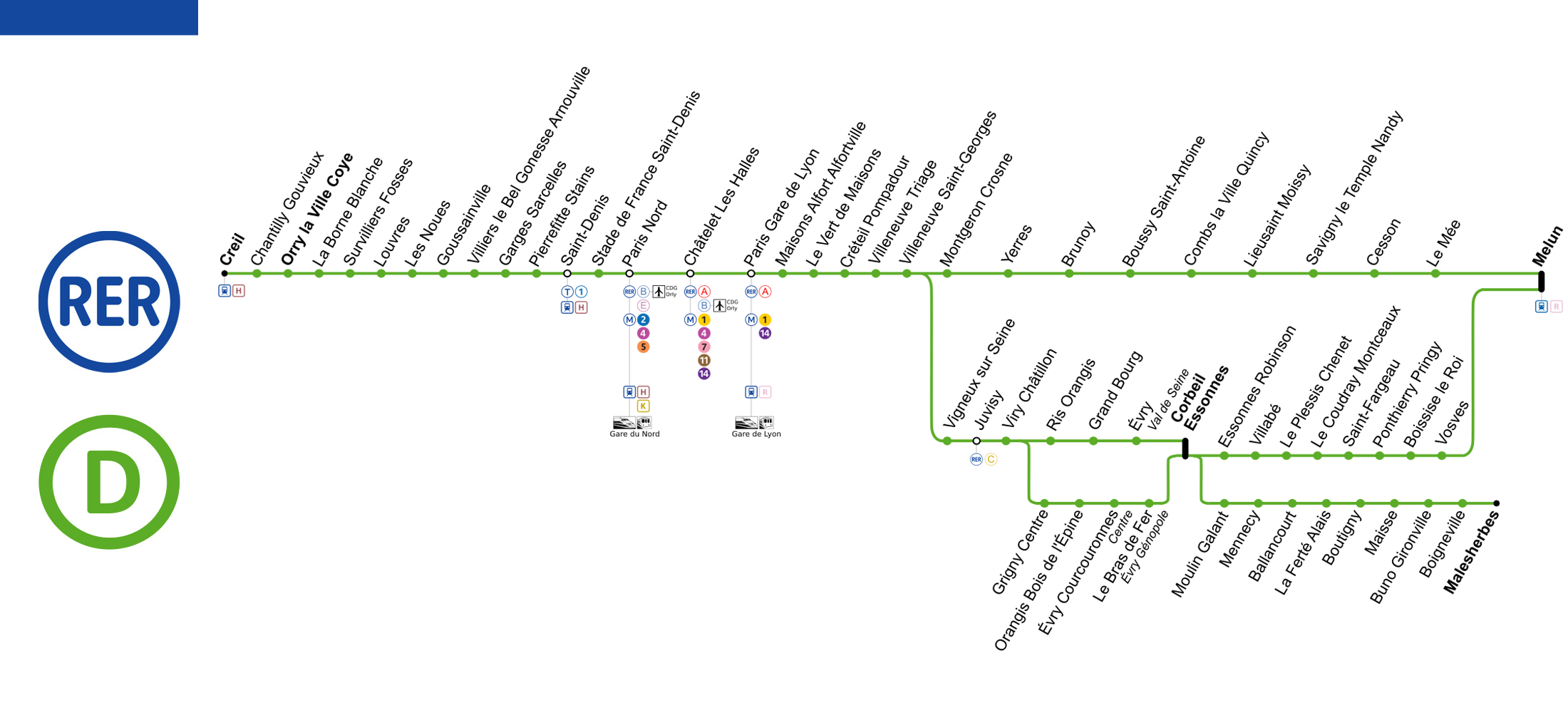
The Paris RER D map connects major stations such as Gare du Nord, Châtelet – Les Halles and Stade de France. This guide covers routes, stations, ticket prices and useful travel tips.
RER D map
🛡 Travel Safety Tip
The RER D connects central Paris with many suburbs and is used by thousands of commuters every day. During rush hour, trains and platforms can become very crowded.
Keep your valuables inside zipped compartments, avoid using your phone near train doors and stay alert when boarding or leaving the train.
RER D Overview
RER D is mainly used by commuters but it serves key hubs such as Gare du Nord, Châtelet – Les Halles and Gare de Lyon, making it an important line for transfers across Paris. It crosses Paris from the north to the south. It connects the cities of Creil and Orry la Ville in the north, to Melun and Malesherbes in the south, through the city center of Paris.
With a length of 197 kilometers, it is the longest transportation line of the parisian network. Over 550,000 passengers use it daily. RER D was inaugurated in 1987.
Tourist attractions on RER D line
The main function of the RER D line is to link the northern and southern suburbs to the centre of Paris. It is therefore not a major line for tourists.
- The Stade de France, stadium of the French national football team, is served by RER D station Stade de France – Saint-Denis.
RER D stations
3 important stations are located on RER D line, mostly to offer connections to other metro and RER lines for passengers coming from the northern and southern suburbs of the French capital.
- Stade de France – Saint-Denis station serves the stadium which hosts the games of the national football team.
- Gare du Nord is the major train station in Paris, where you can take the Eurostar to London. There are many connections to other metro and RER lines.
- Châtelet – Les Halles is the biggest metro station in the world. There are connections to a lot of other RER and metro lines, which allow passengers to go nearly everywhere in Paris.
Airports and Train Stations on RER D
2 of the biggest train stations in Paris are located on the RER D line.
- Gare du Nord is a huge train station serving the north of France, northern Europe with Thalis train and London with the Eurostar.
- Gare de Lyon is a train station which will allows you to reach the south of France, Lyon or Marseille for example.
Metro lines connected to RER D
- Metro line 2, metro line 4, metro line 5, RER B and RER C at Paris Nord.
- Metro line 1, metro line 4, metro line 7, metro line 14, RER A and RER B at Châtelet – les Halles.
- Metro line 1, metro line 14 and RER A at Gare de Lyon.
RER D Ticket price
If you take the RER D within the borders of Paris, then the standard metro ticket price applies, €2.15. However, be careful, you will have to pay more if you travel outside of Paris. A ticket from Paris to the Stade de France will, for example, cost 3.20€.
To compare all public transport options in Paris, including metro, RER, buses and airport transfers, check this complete Paris transport guide.
TIP : Use The 4 Day Paris All-Inclusive Pass and get FREE entrance to the Eiffel Tower, the Louvre Museum, the Palace of Versailles, the Arc de Triomphe, 1 day hop-on, hop-off Paris bus tour, a Seine river cruise, a French wine tasting in the Louvre cellar and many other activities. You would pay much more if you would buy the tickets for those attractions separately.
RER D timetable
You can check the schedule of the RER D line on the site of Transilien.
Ligne Paris – Combs la Ville / Melun
Ligne Paris – Le Vert de Maisons / Villeneuve St-Georges
Ligne Paris – Goussainville / Orry la Ville – Coye La Forêt
Ligne Paris – Juvisy / Corbeil Essonnes
Ligne Paris – Corbeil Essonnes / Melun
Ligne Paris – Malesherbes
FAQ – Frequently Asked Questions About the RER D
Does the RER D go to Gare du Nord?
Yes. Gare du Nord is one of the main stations on the RER D and provides connections to Eurostar, high-speed trains, regional services, and several metro lines.
Does the RER D serve Gare de Lyon?
Yes. Gare de Lyon is a major station on the RER D and offers convenient connections to TGV trains, the Paris Metro, and the RER A.
Can I reach Stade de France using the RER D?
Yes. The Stade de France – Saint-Denis station provides easy access to the stadium and is commonly used for football matches, concerts, and major events.
What ticket do I need for the RER D?
For travel within Paris, a standard metro ticket may be sufficient. For destinations outside Paris, you will generally need a dedicated ticket or a valid Navigo Pass.
Can I use my Navigo Pass on the RER D?
Yes. Navigo Pass holders can travel on the RER D within the zones covered by their subscription.
What are the main stations on the RER D?
Major stations include Gare du Nord, Châtelet – Les Halles, Gare de Lyon, Stade de France – Saint-Denis, Villeneuve-Saint-Georges and Melun.
Does the RER D run late at night?
Yes. Services usually operate until shortly after midnight, although schedules may vary depending on the destination and day of the week.
What is the difference between the RER D and the Paris Metro?
The RER D covers much longer distances than the metro, connecting Paris with numerous suburban towns while providing faster journeys and fewer stops between major stations.
Which attractions can I visit using the RER D?
The RER D provides access to Stade de France, Gare du Nord, Gare de Lyon, Saint-Denis and many destinations throughout the Paris region.
Is the RER D useful for tourists?
Yes. Visitors can use the RER D to reach major train stations, attend events at Stade de France, and connect easily with other metro and RER lines.
How often do RER D trains run?
Service frequency generally ranges from every 5 to 15 minutes, depending on the time of day and the branch of the line.